
There is a lot of variation in higher education governance structures, and alumni associations range from the fully democratic and hands-on to some that are little more than administration-controlled fundraising arms.
The New College Alumni Association (NCAA) was set up to be the vibrant, independent sort. Formed in 1985 as a private association, it was built to democratically channel alumni views and priorities with complete structural independence from the administration. It was inclusive, with membership open to anyone who completed one semester or more at New College.
We served, respectively, as President and Chair of the New College Alumni Association from 1999 to 2002 and mid–2023 to early 2025. We know that upkeep of volunteer-powered organizations is hard. Nonetheless, when the NCAA elected to affiliate with the New College Foundation in 2002, it had $ 290,000 in assets on the books, a full-time executive director, and functioning programming including an official publication, the Nimbus, and a student grants program funded by general revenue and donor-designated endowments.
Other board-designated monies have contributed meaningfully to the College. The Alumnae/i Fellows program has funded alum-led educational offerings ranging from seminars to full-term courses, and the Faculty Development Fund provided conference and research support for faculty in times of limited institutional resources. Further, the NCAA purchased New College’s first professional fundraising database, Raiser’s Edge, which was transferred to the Foundation with the 2002 affiliation. The Chae Professorship in Mathematics was funded by a seed gift from an anonymous alum and a subsequent NCAA development campaign that triggered state matching funds to endow the faculty line. All sources considered, the total funding for this line exceeded $1 million. The NCAA Palm Court initiative raised more than $250,000 in support of scholarships for out-of-state students.
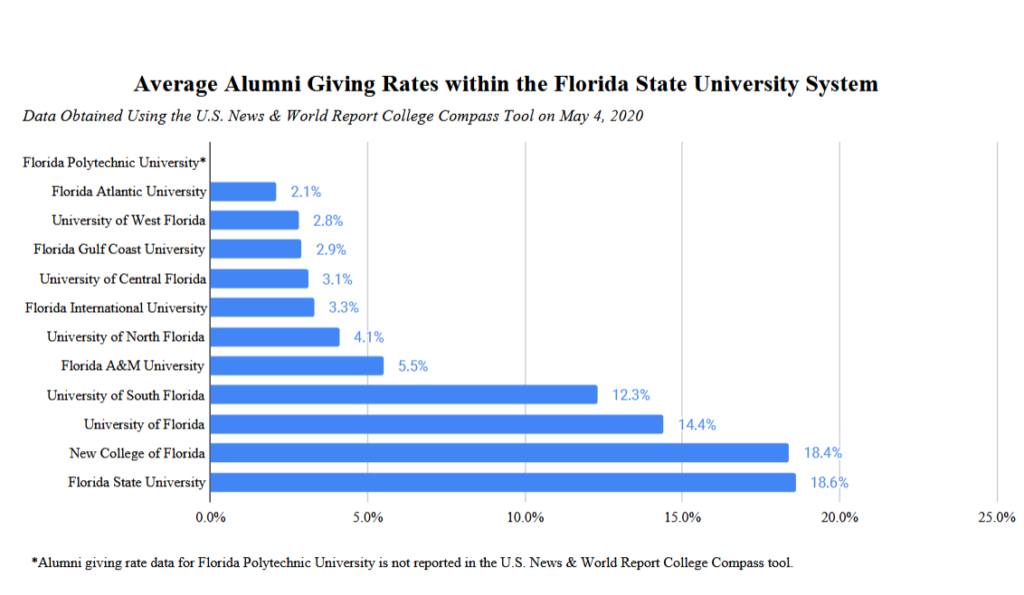
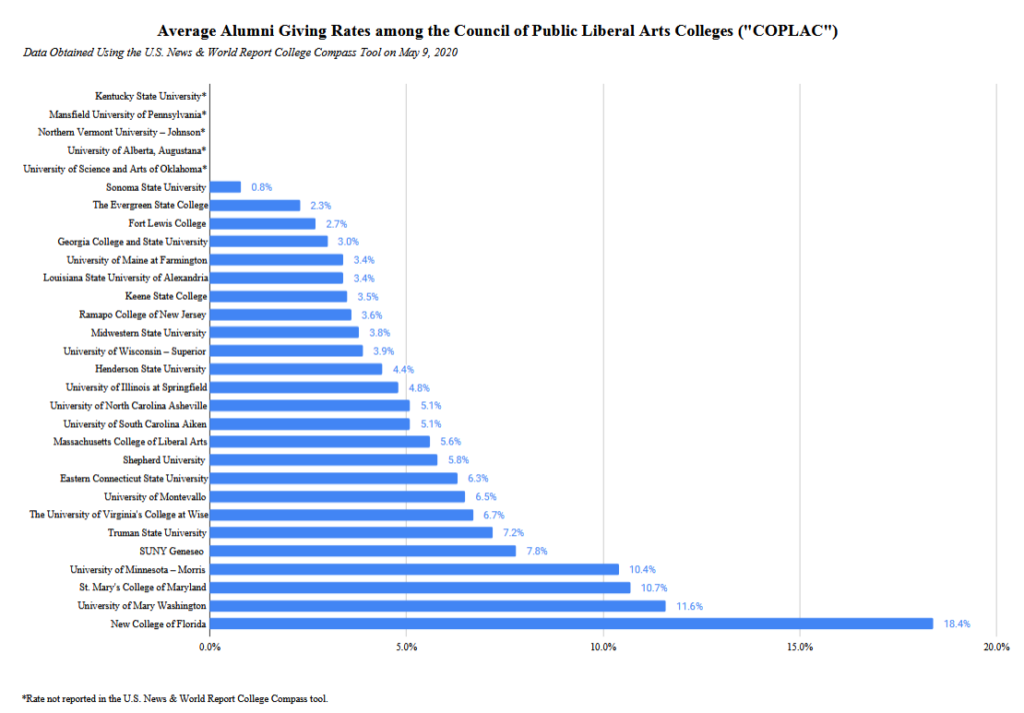
The alumni of New College have provided impressive support given our age and size, including consistent annual giving hovering around 50 percent of members in the years leading up to the Foundation affiliation, a metric placing us in an elite tier of higher education philanthropy. In 2020, the alumni giving rate stood at 18.4 percent, still quite good. That year it was the second-highest in the Florida State University System and the highest among the Council of Public Liberal Arts Colleges. However, as most recently reported by the Corcoran Administration, alumni giving is less than 1 percent.
The New College Foundation’s offer of its administrative resources—relieving some of the workload of unpaid alumni board members—was a component of the NCAA’s 2002 decision to affiliate with the Foundation and transfer primary fundraising responsibilities to salaried development professionals.
Notwithstanding this support for integrated development efforts, the architects of the 2002 deal were careful to protect alumni independence. Among other elements, the agreement with the Foundation protected the NCAA’s editorial control of the Nimbus and gave the Association a say in the selection and supervision of those Foundation staff who would support its work. There was also a clause requiring the continuation of then-existing NCAA programs at roughly equal levels.
Had the 2002 agreement been followed over the years, the NCAA would have had enough independence in 2023 to push back hard on the Gov. Ron DeSantis-designed takeover of New College. Most significantly, if the NCAA had maintained its access to independent outlets to reach the mass alumni public, including the Nimbus and direct access to the mailing list and social media, it could have mobilized a much larger alumni opposition to the takeover. What happened over time instead is a disappointing tale of inertia, lack of traction and—in hindsight—mistakes.
In 2006 the NCAA confronted its first big challenge since integrating with the Foundation, and essentially failed.
The Florida State University System Chancellor was encouraging all foundations supporting public universities in the state to become “Direct Support Organizations” (DSOs), a legal term of art that means they would be more tightly integrated with their respective universities and be subject to a degree of external oversight. The New College Foundation faced a full-court press from the College administration, Board of Trustees and others to accept DSO status. Nonetheless, the Foundation had every right to decline. The NCAA Board submitted a memo advising the Foundation that it looked possible to decline DSO status and maintain an independent course.
But in an April, 2006 meeting, the New College General Counsel reassured the leaders, faculty, alumni, students and donors, stating that “the way in which the Foundation and College currently operate is pretty much the same as it would be as a DSO; there would be minimal changes.” The changes were summarized in the minutes of the April 28, 2006 Foundation Board of Trustees meeting.
But the impact of the changes was not minimal.
Although NCAA leaders clearly had a sense that their independence would suffer under the new DSO arrangement, they didn’t fully foresee its biggest negative effect. Once the New College Foundation took on DSO status, the consistent legal advice from New College general counsels to NCAA leaders was that their proceedings were now subject to the Government in the Sunshine Law, Florida’s broad and stringent open meetings and open records law.
The law is right in its ideals, but goes awry in some of its practical applications. Alumni board members could now no longer talk to one another about NCAA business—or even hypothetical or expected business—other than in a publicly noticed meeting. No more casual brainstorming sessions, no more quick phone calls, no simple problem solving over e-mail or text message. The law prescribes criminal (not just civil) penalties for violations.
Florida’s Government in the Sunshine Law came on the books in 1967, amidst a nationwide movement for more participatory and transparent government. It continues to have broad popular support, but like other good-government reforms in Florida—including the term-limited Legislature—it has had some unforeseen effects, including making bodies with fiduciary responsibilities less agile and more dependent on executives and bureaucrats. In any case, the extension of the law to the NCAA via the Foundation’s 2006 decision to take on DSO status is an application that the good-government pioneers of the 1960s could not have foreseen—one that had difficult consequences for the small, volunteer-run Alumni Association.
There are two reasons why application of the Government in the Sunshine Law to the NCAA is a strange result. The law is meant to check unaccountable power—it came about in an environment of pork-barrel spending led by rural, Democratic lawmakers who had a firm grip on the Florida Senate. These lawmakers leveraged unequally apportioned legislative districts to maintain outsize influence. They also had a practice of meeting at a fish camp, well out of the public view. The marginalization of voters through unequal districts, de jure racial segregation, and unaccountable expenditures from the public fisc—these factors were fresh experiences when advocates finally succeeded in passing the law. Today, the law provides needed transparency into state agencies, some of which have budgets of several billion dollars. Such institutions implement their decisions through vast teams of staff, and they sometimes directly wield the implements of state violence. New College itself, with its budget of about $101 million and its campus police department, is an arm of the state—and its governing Board of Trustees is subject to the Government in the Sunshine Law.
The NCAA never had a level of power that registered on the state agency scale. The NCAA board had limited staff support, and no staff who reported exclusively and directly to it. In recent years, due to the Foundation’s violation of the 2002 agreement, the NCAA had a minimal or nonexistent budget. It engaged in modest activities such as planning alumni reunions and publishing a newsletter. Rather than order staff to implement its plans, the board would do the detailed work itself. Reliance on board member volunteers for such work required the NCAA board to have even more meetings, all under cumbersome Government in the Sunshine procedures. In contrast, in a typical Florida state agency, once the broad terms of a project or initiative are set by the governing board and the effort is passed on to paid staff, no further Sunshine-compliant meetings are needed.
The Government in the Sunshine Law was meant as a check on the public sector, on government. But the basis of the NCAA’s 2002 integration with the Foundation was that the NCAA would bring private resources—the $ 290,000 in funds it had raised—to a partnership with the Foundation, which was also at the time an unquestionably private institution. The application of DSO status to the Foundation subverted the private, grassroots, volunteer-oriented character of the NCAA, bringing privately-raised funds under an extraordinary level of state oversight and control.
One might suppose that such a tight integration carried a silver lining, though, by bringing alumni within the formal governance structure of the College. But sadly, even before the January, 2023 transformations, the New College administration exploited Government in the Sunshine to prevent alumni from gaining a meaningful position within the institution. After joining the NCAA board in 2019, Ben found it very hard even to get an item proposing a greater alumni role in a College process, such as a presidential search, or an item that criticized the administration into the Association’s meeting agenda. Because of the public notice requirement, he was also at the mercy of administrative staff (who primarily answered to the Foundation) to schedule any type of meeting, even an informal conference with other board members.
The NCAA’s position within College governance waned over time. To compare: as NCAA President in 2002, Mike joined several other alums on the robust 2002 search committee that selected Gordon Michalson as the inaugural president of the newly independent New College. But when a presidential search to replace Donal O’Shea was underway in 2020, input from the NCAA was not invited. On its own initiative, the Association adopted a three-page document with bullet point recommendations and submitted it to the presidential search committee, where it had no representative. Initiated by a single NCAA board member, the effort wended its way through infrequent, cumbersome, Sunshine Law-compliant meetings to its three-page official result.
It is worth noting that this much-weakened version of the NCAA is what the new slate of trustees appointed by DeSantis encountered in 2023. No wonder the NCAA managed no official input at all into the 2023 presidential search that concluded with the installation of Richard Corcoran.
In our view, the NCAA’s denouement began not on January 6, 2023, when the takeover of the College was announced, but in 2006 when the Foundation took on DSO status. The reason we don’t fix the date in 2002, when the Association first integrated with the Foundation, is because the alumni board members at that time were careful to preserve much of their independence through language in the formal Affiliation Agreement. It was the DSO status and the difficulties of operating under Government in the Sunshine that prevented the Affiliation Agreement from being robustly implemented and maintained.
Ultimately, a succession of NCAA boards repeatedly failed to stand up for their rights under the Affiliation Agreement. At the beginning of 2023, the Association had an administration-aligned Chair, Dan Stults, who himself disclaimed the agreement, arguing that it was obsolete. When DeSantis made his move on New College in 2023, the NCAA had a good relationship with the College administration but a poor relationship with its alumni-members, and little independent access to resources with which to fight the takeover.
In hindsight, fighting back hard would have been the right approach. Rather than simply implementing their stated plans for a conservative re-branding and re-direction, we believe the takeover team has turned the College into a fiscal and operational disaster, rife with questionable expenditures to pay politically-connected individuals.
Mike joined other past NCAA leaders to found the Novo Collegian Alliance (NCA) in 2023. Since resigning as Alumni Association Chair in 2025, when he saw no other way out, Ben has also joined the leadership of NCA. NCA is a private, democratically run alumni-centric organization that isn’t intertwined with the College at all. We suggest alumni head over to NCA or a similar effort such as NCF Freedom if they are still interested in organizing, mutual aid, helping students and a voice in the public square. NCA also welcomes the participation of current students.
Some closing thoughts: We believe most will welcome this record of our collective accomplishments, mistakes and good faith efforts as we head into the unknown together. The achievements of alumni in the short history of New College are remarkable, and the alumni remain an asset—if they are meaningfully engaged by the College. We suspect that the Foundation’s action to dissolve the NCAA will be seen in retrospect as a strategic error by an administration beset by insularity and brittleness, unwilling to tolerate independent institutions and voices within the school’s governance and support scheme.
Ben Brown is a former New College Student Body President and former Alumni Association Chair. He currently serves on the Board of Directors of Novo Collegian Alliance, Inc., an independent alumni organization. Ben is a practicing education lawyer in New York State, representing students and their families.
Mike Campbell is past president of the New College Alumni Association and a former trustee of the New College Foundation. He currently serves on the Board of Directors of Novo Collegian Alliance. Mike is Professor of Psychology and Global Health in the Faculty of Medical Sciences, University of the West Indies, Cave Hill, Barbados.