
I was taking notes on international relations theory at a library in The Hague, Netherlands’ administrative capital, when two college-aged girls with perfectly applied eyeliner and off-shoulder sweatshirts giggled as they sat down at a table in front of mine. They began discussing the recent war between the United States and Iran, and one of them quipped that, as a German, she was glad her country had not started a third world war.
The conversation turned to their shared hatred of poetry class. The two laughed at a poem they had been assigned in class for not rhyming, and they called the whole medium of poetry stupid.
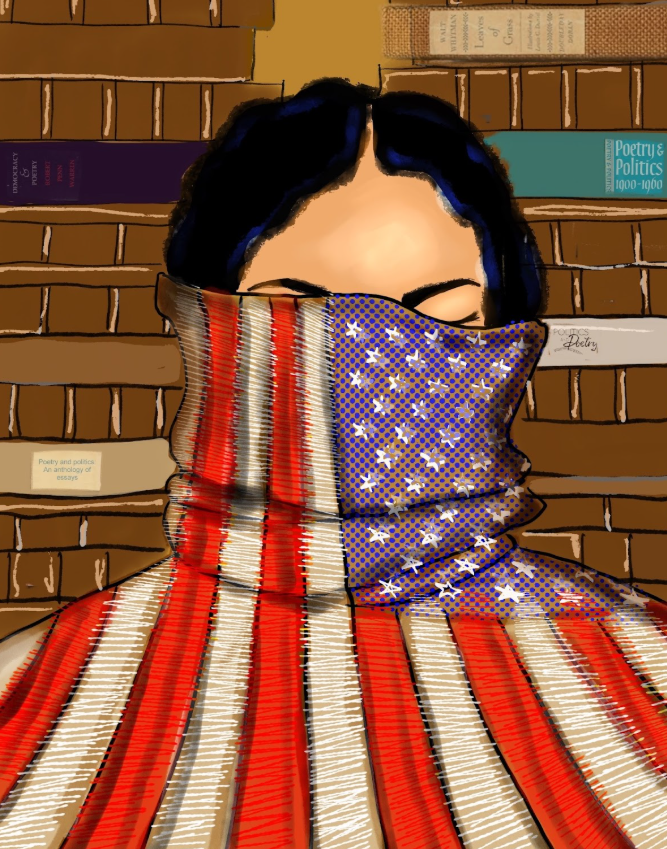
I was surprised and saddened to hear this because, to me, poetry and politics go hand in hand. Poetry is a way to make sense of the world, a life raft for the murky and terrifying current that propels people along the uncertainty of life. To say poetry is stupid is to dismiss the tools that artists, poets and other authors offer us to navigate our current political moment.
All art is related to the context within which it is created. Poets interpret pedantic politics and war statistics as graspable and soulful, for poetry is politics but with a heart, a person writing the exact feelings that are stuck in our throats.
“In the intervening years, political poetry, even here in America, has done much more than vent,” former U.S. Poet Laureate Tracy K. Smith said in 2018. “It has become a means of owning up to the complexity of our problems, of accepting the likelihood that even we, the righteous, might be implicated by or complicit in some facet of the very wrongs we decry.”
Robert Penn Warren was the first U.S. poet laureate, earning the title in 1986 after publishing his critical essays in Democracy & Poetry a decade earlier. The poet laureate title evolved from a consulting role for the Library of Congress that was established in 1937.
Since then, American poets have had ties to the federal government and participated in everything from presidential inaugurations to state-sponsored missions to the Soviet Union to complicated conversations about poets’ roles in furthering fascist agendas. In her 2023 book, The American Poet Laureate: A History of US Poetry and the State, Amy Paeth wrote, “In the postwar period, the state had learned the lessons from the Library of Congress not to involve itself outwardly in ‘questions of taste’ … but it had also learned the power of poetry in shaping political ideologies.”
Walt Whitman, a journalist as well as a revered poet, considered himself a poet laureate some 100 years before the role was established. As Whitman wrote, “[The poet] is the arbiter of the diverse and he is the key. He is the equalizer of his age and land,’ he explained. ‘He supplies what wants supplying and checks what wants checking.”
Whitman maintained that poets are also archivists who hold leaders accountable. Poets document current affairs to be read, analyzed and agonized over by future generations of literature students.
Poets continue to witness and translate what is happening here and now. Forugh Farrokhzad, a controversial, due to the sexual nature of her poems, modernist and feminist Iranian poet, demonstrated this in her poem, “I Feel Little Garden’s Pain”: “Nobody cares for flowers. / Nobody cares for birds. / Nobody wants to believe that Little Garden is dying.” She continues: “Our neighbors’ basement looks like a secret arsenal base. / Our neighbor’s children are fighting with noisy guns and bombs. / Our courtyard is feeling scared.”
Farrokhzad expressed her helplessness as the beauty of life was snuffed out around her. While the poem was written in the 1950s, a period of violent political upheaval in the country, it could be applied to the rising death toll in Iran and neighboring Middle Eastern countries since the launch of the US-Israel attacks earlier this month.
Famed Harlem Renaissance poet and civil rights activist Langston Hughes wrote in 1935, “Let America be America again. Let it be the dream it used to be.” Nearly a century later, contemporary Puerto Rican performer Bad Bunny proclaimed “God bless America” at the Super Bowl XL halftime show where he paid tribute to every country in the Americas. Our modern-day songwriter superstars are carrying this tradition of political poetry into the present.
At the University of Maryland, Professor Juan Carlos Quintero-Herencia teaches a course called “Contemporary Puerto Rican Musicality,” which includes a section on Bad Bunny. In an article about the course on the university’s website, Jessica Weiss writes, “From gentrification and displacement to economic and environmental sustainability, Bad Bunny shines a light on some of Puerto Rico’s most urgent realities.”
“He makes constant references to Puerto Rican history,” Quintero-Herencia explains.. “And people around the world are learning about these issues—not from academia or politics, but because of Bad Bunny.”
Poetry forces readers to acknowledge the ugly or the unjust. In Michael Kleber-Digs’ “America Is Loving Me to Death,”the first letters of each line spell out the title of the poem and the last words of each line evoke the words of the Pledge of Allegiance: “Destroyed brown bodies, dismantled homes, so demolition stands / Even as my fidelity falls, as it must. She erases my reason too, allows one / Answer to her only loyalty test: yes or no, Michael, do you love this nation? / Then hates me for saying I can’t, for not burying myself under / Her fables where we’re one, / indivisible, free, just, under God, her God.”
Kleber-Digs explores the paradox of the U.S. claiming to love and support Black Americans while simultaneously enforcing systemic oppression. The poem is a call to action for readers to consider their own complicity in their loyalty to an America that does not show “liberty and justice for all.” Politics should force viewers to critically examine their alliances, just as Kleber-Digs’s poem commands.
These brave writers flashed in my mind as I listened to the girl’s dismissal of poetry as a political art form. Even the first poem ever recorded, “The Epic of Gilgamesh,” tells the story of a king’s quest for immortality and his transformation from tyrannical ruler to one with a moral responsibility to his subjects—a lesson applicable to today’s power-hungry world leaders.
The poet can be understood as an orator for the political if readers release commonly held apprehensions about poetry’s perceived impenetrableness and dive in.