
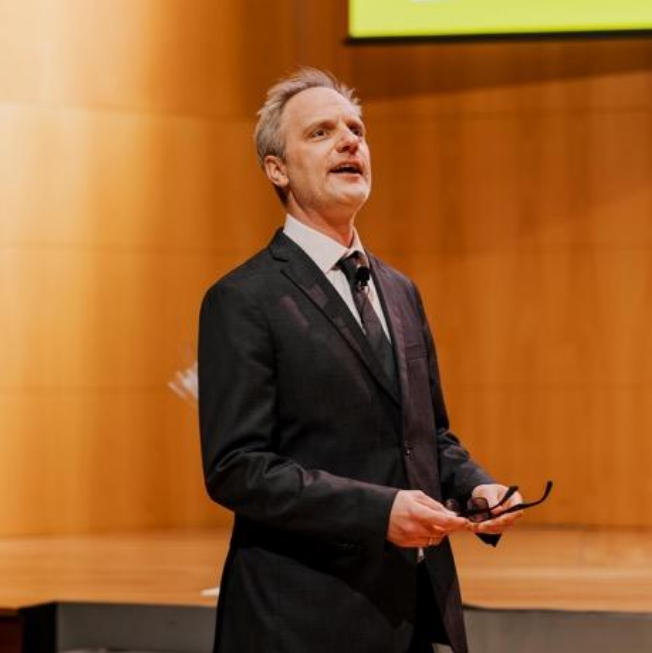

Dave van Ginhoven, Senior Lecturer at the Hague University of Applied Sciences in the Netherlands, has dedicated more than 15 years to teaching the indispensable skills of media literacy and critical thinking. A child immigrant, Ginhoven has worked as an historian, journalist and educator across the Netherlands, Canada and the United States, studying media and politics for decades. His main takeaway?
“If I can help you be a better thinker, then the chance that you’re going to be a racist or white supremacist is smaller,” he told Old School Catalyst in an interview at his campus office.
Van Ginhoven’s focus on communication skills is more than academic. His family is from the Netherlands, where all four of his great-grandparents served in the World War II resistance effort. Huibert Cornelius van Ginhoven, his great-grandfather, primarily smuggled information and people to England, including young men who wished to join the British in their efforts or to support the Dutch government in exile.
“It’s hard to have any kind of straight narrative because no one wrote things down properly,” van Ginhoven said. “So, the stories that you get are stories that somebody half remembers. And this particular generation didn’t like to talk about it all. They’ll say, ‘We did not want to trouble our children,’ which is really sad because they troubled their children by passing on their trauma instead of talking about it.”
Huibert was caught when he attempted to smuggle a man who requested help from an undercover collaborator with the National Socialist Movement in the Netherlands (NSB), or the Dutch Nazi Party. Huibert and his brother were taken to the Scheveningen Prison in the Hague. Today, a section of the prison is used by the United Nations as a penitentiary for those awaiting trial at the Hague’s Court of Justice. The other section of the prison is a museum known as the Oranjehotel, where the German occupiers held more than 25,000 people.
“The Netherlands loves to talk about its resistance history, but most Dutch people weren’t in the resistance, and most Dutch people weren’t on the other side either,” van Ginhoven explained. “Most people kept their heads down and tried to survive. This country let the Germans take 135,000 Jews and put them on trains and only 35,000 of them came back.”
Van Ginhoven’s immigrant experience stretches back generations as well. Both sides of his family moved to Alberta, Canada in the 1950s. The area saw a large influx of Dutch immigrants around this time. None of van Ginhoven’s grandparents attended high school and both sides were working class. Van Ginhoven commented that one of his grandfathers, who worked on a farm upon arriving in Canada, had his bag checked every day by his employer to make sure he wasn’t stealing.
“I always think this a funny story to tell people, to remind them that unfair stereotyping of migrants is not a new thing,” van Ginhoven said.
By the late 1960s, van Ginhoven’s father relocated his family to Orange County, California.
“When I was 10, I didn’t think anything of moving from Canada to the U.S.,” van Ginhoven said. “We all speak English, I’ve seen The Cosby Show. But there were a lot of cultural differences. I remember being laughed at in school because I had to read something that mentioned somebody named Juan. But I didn’t know Spanish, because I’m from Alberta. They don’t speak Spanish out on the Prairie, man.”
Over the course of his childhood, van Ginhoven moved from California to Greenville, South Carolina, before returning to the Hague, Netherlands. Van Ginhoven said he looked forward to leaving what he deemed the “too-formal South” for a 12-year-old boy.
“There’s no such thing as a blue and red state, just blue and red people,” he said. “And a lot of great people are in South Carolina, but I also went to high school with kids who thought God created AIDS to punish homosexuals for sinning.”
As a teenager and young adult, van Ginhoven found an escape through writing. Science fiction, film, theater, comedy and journalism were all outlets he turned to. He attended Emerson University in Boston, where he majored in Film with the intention of becoming a screenwriter, but later earned his MA in English Literature from Leiden University with the goal of becoming a teacher. Instead he worked for an English-language newspaper that called itself The Amsterdam Times and The Hague Times in its respective cities.
“I worked there for three years,” van Ginhoven recalled. “By the end, I was editor-in-chief. That sounds impressive, but we were a low-budget operation. I was also the main photographer, I did layout, I wrote half the newspaper and edited the other half.
“You tell a lot of negative stories [as a journalist] and you look at ugly things in the world,” he continued. “Racism, Islamic extremism, white supremacy and all these things weighed on me. I thought if I went into education, I could be part of putting more positive stuff into the world.”
This Old School Catalyst reporter took van Ginhoven’s 21st Century Political Communication course as part of her study abroad program at the Hague University of Applied Sciences. Today in his classes, Van Ginhoven covers subject matter that includes climate, anti-migration sentiment, political polarization and Islamophobia. They are discussed as if they are fresh topics, although they have been plaguing society for generations.
“I don’t believe that all teachers are part of a left-wing conspiracy to indoctrinate,” he said. “I can’t even indoctrinate students to use proper APA style referencing. I have no interest in telling people what to think or how to vote. But what I do think is my job as a teacher is to teach you how to think critically about information you interact with.”
Van Ginhoven said that his main emphasis as a teacher is media literacy. According to him, when governments or societies shut down the opposition, they only fuel the opposition’s sense that they are being persecuted by the elite.
“I think the only real weapon is media literacy,” he continued. “Making sure people can understand when they’re being lied to, or when the facts don’t add up.”
Van Ginhoven stressed that one of the driving factors of today’s polarization is the loss of empathy, further exacerbated by the Internet, which allows people to argue with text over a keyboard and not face-to-face.
“And there is no [in-person] space to have these conversations,” he elaborated. “Imagine a little old lady who lives in a neighborhood somewhere in the Netherlands and everybody looks like her, speaks the same language, and went to the same church 40 years ago. And one day, she opens her window and sees a woman in a head scarf passing by, and she’s never seen one before. Then years go by and she sees more and more headscarves. She needs a moment to adjust.”
The fact that the woman is uncomfortable, according to van Ginhoven, does not automatically make her a racist.
He explained that a collective lack of empathy for the other makes polarization worse and progress more difficult. Voters who have different needs or stem from different socioeconomic backgrounds are lumped in with the party they vote for, whether or not they agree with everything that party stands for.
Van Ginhoven said that in order for society to progress, politicians must prioritize the needs of their constituents “without demonizing foreigners,” adding that this doesn’t address the root of a citizen’s problems.
“It’s just a way of distracting them [constituents] from the larger forces that are actually to blame. If you have those conversations with people, then there’s a chance of actually getting somewhere. But if you’re unwilling to see them as people who have their own challenges or their own problems, then it’s very difficult to reach them.”