
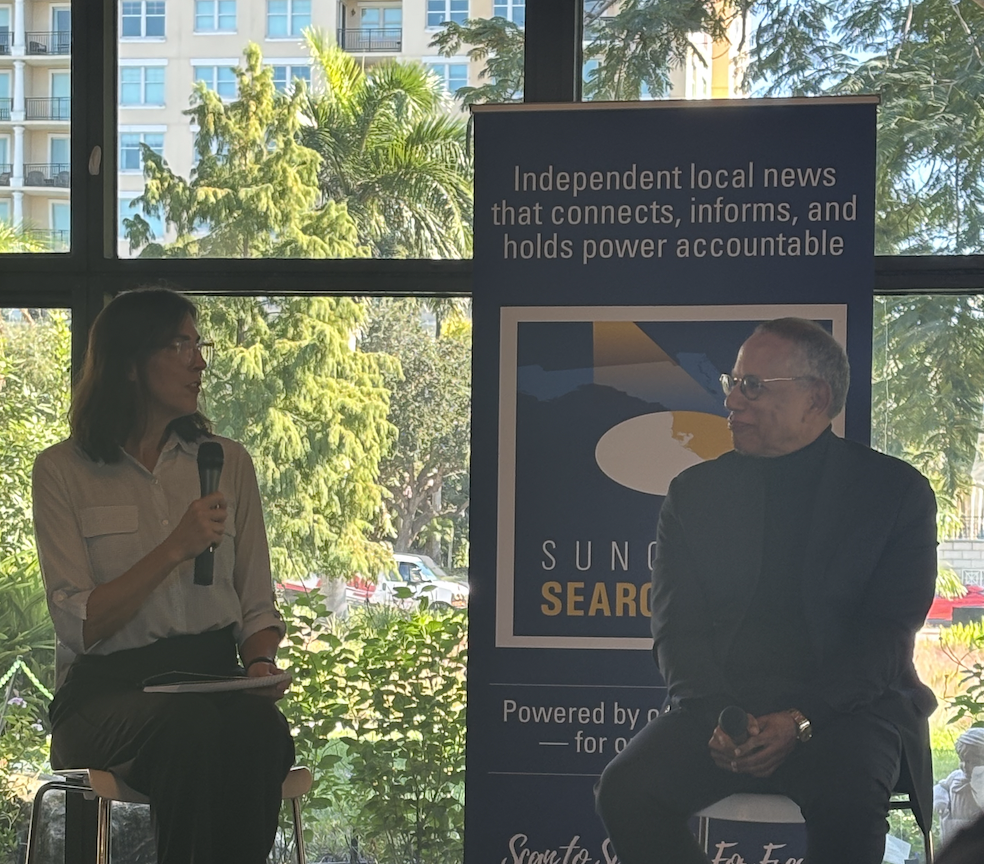

On Nov. 13 at the Sarasota Garden Club, a lush green venue along Sarasota’s Boulevard of the Arts, local nonprofit investigative news collaborative Suncoast Searchlight hosted Dean Baquet, current executive editor of the New York Times Local Investigations Fellowship. The free event lasted an hour, as part of the “Searchlight Series,” which explores public understanding of the media industry and aims to shorten the gap between community members and the journalists who serve them.
“If we do the things we are supposed to do, it will be clear who is real and who is not,” Baquet told the crowd of about 50. This Old School Catalyst reporter was the youngest by decades, but not the only attendee with a passion for journalism. Audience members were engaged in the Q&A and several people stood in line afterward to speak to Baquet.
Well known as the former executive editor of The New York Times, Baquet was visiting Florida for the Poynter Institute’s annual Bowtie Ball, where he was being honored. A Suncoast Searchlight board member, Chris Davis, works with Baquet on the Local Investigations Fellowship, an initiative that provides guidance to local journalists who pursue investigative stories about their local cities for publication in the Times.
Baquet told the Sarasota audience that he was born in a working-class Creole neighborhood in New Orleans in 1956. Prior to working at The New York Times as Washington bureau chief, managing editor and executive editor, he reported for The Times-Picayune in New Orleans and the Chicago Tribune. Additionally, he held top editorial positions at the Los Angeles Times. Baquet was awarded a Pulitzer Prize for investigative reporting in 1988 for his documentation of corruption in the Chicago City Council. He was also a Pulitzer finalist in 1994 for his work investigating fraud at a U.S. nonprofit health insurer.
Suncoast Searchlight Executive Editor-in-Chief Emily Le Coz asked Baquet questions from the audience that had been submitted in advance. Responding to these questions, Baquet said that the state of journalism is a mixed bag: the craft of investigative reporting is stronger than ever, but the business of journalism is struggling. Advertising, Baquet stressed, is not as powerful as it used to be, which he views as something positive. He explained that advertisers could attempt to censor the journalists they supported, and the minimization of their authority would help to ensure journalistic integrity.
When asked about his own work and whether he had ever faced censorship, Baquet shared an anecdote about The New York Times investigation of Hollywood director Harvey Weinstein’s sexual harassment scandal in 2017. Notably, the Times publisher did not mention to Baquet that Weinstein was one of the outlet’s “biggest advertisers” until after the story was published.
Baquet shared his concern for the death of local journalism in many places. He stated that on a trip to Chicago a few years ago, he visited the Chicago Tribune building where he’d worked for many years, finding that it had been transformed into condominiums. Baquet attributed the national surprise at the outcome of the 2016 election to the lack of local journalism.
“The collapse of local news [means we] lost the ability to understand what people care about locally,” Baquet stated. He explained that the death of local journalism has “contributed to divisions in the country [because people] do not fully understand their country and the sense of feeling adrift or not connected with their country” has grown as the number of local papers has dwindled. AP News reported in 2024 that “more than 3,200 newspapers have closed since 2005, leaving roughly 5,600 remaining” and that “nearly 2,000 newsroom jobs were lost” in that year alone.
Baquet said that cities without at least two local papers are not first-class cities, that local papers must be supported by their community members and they should feel connected to their journalists.
“In my fantasy, you get to the point where the local news organization becomes like the library or the museum,” he stated. “You want to have somebody who covers your community, and you contribute to it—and it’s not just five zillionaires or five giant philanthropies—that people actually subscribe, pay for it.”
Baquet named ProPublica, a nonprofit investigative newsroom based in New York City, as an example of a local outlet shaping the future of the journalism industry. ProPublica’s investigation of Supreme Court Justice Clarence Thomas secretly accepting vacations and money from wealthy donors won the news outlet a 2024 Pulitzer Prize for Public Service.
While major investigative reporting can win awards, major backlash can follow as well.
“I think it’s a relatively new tactic,” Baquet said about lawsuits filed against media organizations. “It’s particularly treacherous, and I think it’s designed to squash free flow of information.”
Baquet credited President Donald Trump for starting this trend—also citing ABC’s $15 million settlement with Trump over a defamation lawsuit and Disney’s initial suspension of late-night talk show host Jimmy Kimmel to appease conservative viewers and the Federal Communications Commission.
According to Baquet, the Trump administration has emboldened local viewers to see journalists and the media as an enemy and perpetrator of fake news.
“We [as journalists] need to get better at telling our story,” Baquet said. “People don’t understand how hard journalists work to get it right.”
Recently, two top executives of the British Broadcasting Channel (BBC) resigned after a leaked memo suggested the network had inappropriately edited a speech by Trump that portrayed the president as inciting violent protests during the Jan. 6 attack on the U.S. Capitol. Trump threatened a $1 billion lawsuit if the BBC did not retract the video and apologize. The BBC chair issued an apology, but the news organization would not provide legal compensation.
“In public life leaders need to be fully accountable, and that is why I am stepping down,” CEO of News Deborah Turness wrote in her resignation statement. “While mistakes have been made, I want to be absolutely clear, recent allegations that BBC News is institutionally biased are wrong.”
Baquet stressed the need for transparency in order to keep the news industry alive, such as the BBC executive’s apology. Journalists need to connect with their community and explain current events “to people in meaningful ways.”
“It is a difficult time to be a journalist, [but] being a journalist is 50 times more fun,” Baquet quipped with a smile. “It’s a blast to be a journalist.”
He told the audience an ironic story about how his neighborhood childhood bully was the accused in a criminal trial he covered as a reporter. “I walked into the courthouse and I sat down and the neighborhood bully was on trial for murdering his drug dealer,” he said.
The world of news media is contentious and dwindling in opportunities. Yet, students of journalism and community members outraged at the weaponization of the news industry should not lose heart. Transparency and local nonprofit news, as Baquet highlighted, are the solutions that can only succeed with support from the community.
“You have to just do it,” Baquet concluded. “The impact on the world is really meaningful. Do the work, get it right, explain why you do it.”