
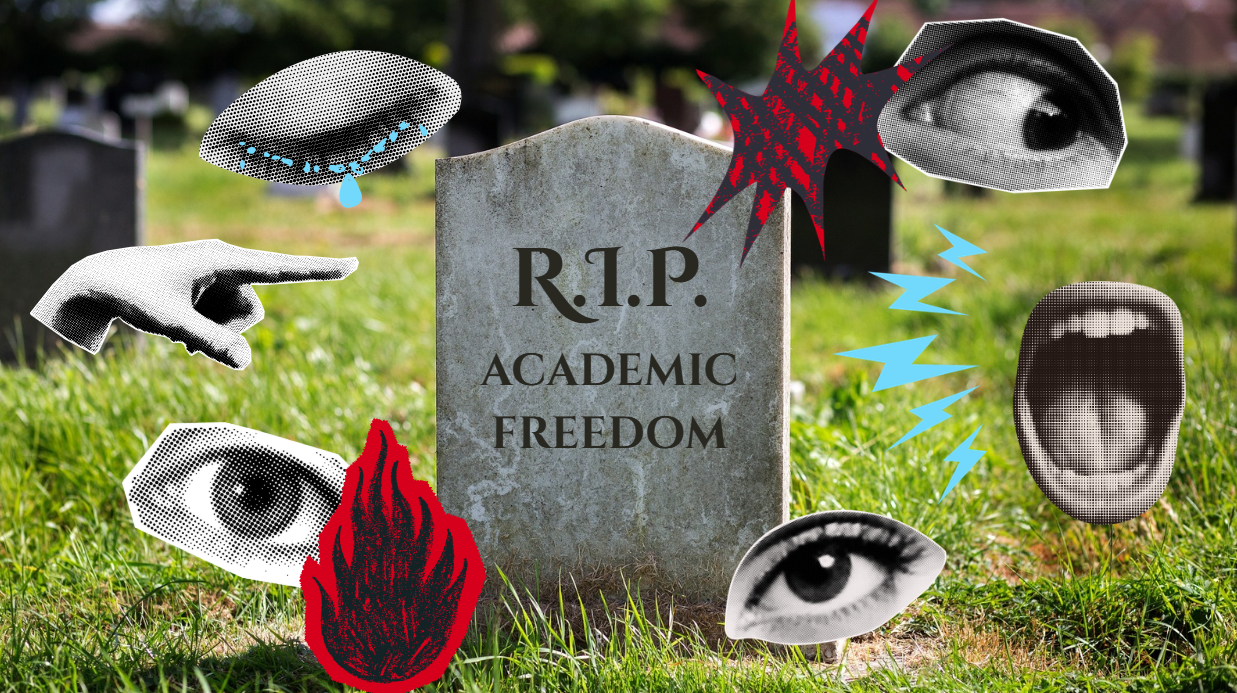

A horse-drawn funeral carriage full of banned books in lieu of a body. An interactive web browser game that puts you in the shoes of a high school student facing down web filters. A giant puppet show rife with Big Brother imagery about the dangers of data surveillance.
What do these things have in common? All are initiatives spearheaded by Students Engaged in Advancing Texas (SEAT), a youth-led nonprofit dedicated to normalizing student engagement in policymaking. As their motto states, “Nothing about us without us.”
Texas, like Florida, South Carolina and Arkansas, has seen a recent increase in what some organizations call educational gag orders—legislative restrictions on curriculum, institutional programming and classroom speech. In Texas, K-12 schools are prohibited from “developing or implementing policies, procedures, trainings, activities or programs that reference race, color, ethnicity, gender identity or sexual orientation,” and teachers are discouraged from discussing current events. In higher education, Texas legislation establishes a governing board for each university which has sweeping powers to approve, deny or overrule decisions regarding the general education curriculum.
Texas State University faculty members have also been targeted for engaging in off-campus speech. Former Associate History Professor Thomas Alter was fired for speaking at an “online socialism convention.” Professor of Philosophy Idris Robinson was fired for speaking about the conflict in Gaza at an event in another state. Following a federal judge’s ruling, Robinson was reinstated.
A federal judge also recently ruled that Texas students can face repercussions, such as written reprimands placed in their permanent records for making “celebratory comments” about Charlie Kirk’s killing.
For SEAT co-founders Cameron Samuels and Hayden Cohen, the fight to make their voices heard started when both were high school students. Samuels and Cohen, who serve as SEAT’s Executive Director and State Policy Director respectively, first began combatting book bans, web filters and Internet censorship in Texas schools as early as 2021. Samuels notably coordinated with the American Civil Liberties Union (ACLU) of Texas and Lambda Legal in order to “restore access to LGBTQ-affirming websites” in nine Texas schools.
“Student representation [being excluded] in policymaking is what we identified as an issue with us in Texas,” Samuels told Old School Catalyst. “My personal experiences began in my school district in high school where I was fighting book bans and censorship, and seeing myself in the curriculum and in our library was a prelude to seeing myself in policy, seeing that I can offer my story, my narrative, to change the world.”
As a former Texas senator and Chancellor of the Texas Tech University System, Brandon Creighton has issued a recent order for institutions to “phase out” gender studies programming, SEAT has fought to maintain their seat at the table. Creighton issued a memo on April 10 for all five Texas University System institutions to cease offering programs “centered on sexual orientation and gender identity,” abbreviated as SOGI.
This memo also includes a prohibition of advocacy that discusses “racial or sexual superiority, inherent bias or collective guilt,” as well as a stipulation that future faculty hiring decisions must “prioritize recruitment in alignment with this memorandum.”
Creighton’s memo does include exceptions for upper-level and graduate courses and independent student research, but will prohibit all majors, minors, certifications, graduate degrees, masters theses and PhD dissertations that fall under the SOGI umbrella starting with the incoming 2026 cohort. Textbooks with SOGI material will not need to be redacted or removed, but faculty are prohibited from highlighting this material, spending class time on it or including it in tests.
Texas university provosts have until June 15 to identify offending programs and prevent incoming students from declaring majors or minors in said programs. According to the Texas Tribune, Creighton has said that an AI algorithm, built to weed out offending courses, flagged 1,403 courses in the state university system.
For Creighton, this new memo is “reinforcing academic integrity.” For SEAT and other student organizing groups, it has ushered in a period of mourning.
SEAT’s most recent demonstration on May 7 was a funeral for the Texas Tech University System, complete with students in mourning attire, a hearse with a funeral urn led by two black horses and eulogies for the spirit of academic freedom. The procession was scheduled around a Texas Tech University System Board of Regents meeting that same day, in time for participants to give verbal testimony.
“It is a memorialization of the grave consequences that these policies have…we are holding them accountable to the harm that they’ve done to us,” Samuels said. “Many of the speakers during the eulogies expressed that these decision-makers have effectively murdered the university.”
Both SEAT co-founders described a grim scene at Texas’ institutions. Cohen, who is a senior at the University of Houston-Downtown, is applying to graduate schools out of state. They say they’re not the only one planning their escape route.
“A lot of students are still in the middle of earning their degrees and feeling these effects, and that makes it difficult to transfer and leave, because you’ve already invested all of this time and money and energy into working toward your degree,” Cohen explained. “I’m not staying in Texas for this precise reason…and I know there are quite a few other students who are graduating high school who are planning to leave because of this.”
Samuels, who is pursuing their Masters at the Lyndon B. Johnson School of Public Affairs at the University of Texas, has witnessed faculty being pushed out for not demonstrating their explicit loyalty to the state university system. SEAT hosted an event on Samuels’ campus in March about university censorship that, they explain, the dean was pressured by the president to cancel. The dean allowed the event to continue as planned, and a few weeks later, his contract was not renewed.
Both warned that things in Texas are likely to get worse, and that SEAT is fighting an uphill battle. The extant powers of student government leaders appears to be next on the chopping block, said Cohen.
“Every Board of Regents gets a student member, but those are hand-picked by the Governor,” they continued. “And when members of the student body try to get a hold of their student representative on the Board of Regents, that’s becoming difficult. And so how little students actually have a voice is a really important piece to the puzzle here.”