

From 1969 to 1970, at the height of the American counterculture movement, a politically radical underground newspaper provided a platform for queer and women’s voices. Free Spaghetti Dinner, a biweekly paper published in Santa Cruz, California and founded by Berkley alumnus Rick Gladstone, initially sold for 13 cents an issue before it was later distributed for free. The paper derived its namesake from the motto, “All the news that’s fit to eat.”
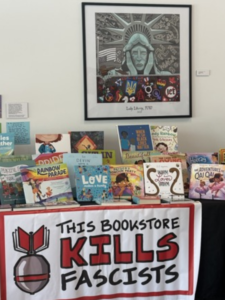
Alternatives to mainstream media in the United States can include everything from Thomas Paine’s revolutionary era Common Sense to zines—non commercial, often homemade publications distributed at the hyperlocal level—created by artists and authors as early as the 1930s. Alternative media are platforms that exist outside corporate or mainstream legacy media that address topics often seen as radical or from society’s marginalized perspectives.
Such media had been the Freudian iceberg beneath the surface of every political movement. Often emerging as voices for counterculture, alternative media are a way for the ostracized to foster their own communities and cover stories neglected by the mainstream.
Mainstream media lean on neutrality at a time when readers’ confidence is waning. For example, an October 2025 study by the Pew Research Center found that only 56 percent of U.S. adults trusted the information they received from national news. Big news corporations also appear to be more explicitly profit driven. For example, Jeff Bezos’ acquisition of The Washington Post has led not only to thousands of layoffs but also to thousands of subscriptions cancelled.
In contrast, alternative media often lead with their mission and offer a place for those who wish to connect with like-minded readers. Rather than relying on name recognition or longevity, alternative media establish their trustworthiness through the relationship between a product and its creators.
The age of the internet has paved the way for alternative media to reach wider audiences. Consumers have access to more news sources than ever before, making it easier to rely less on mainstream media and instead seek more specialized outlets. However, scholars do point out that this has contributed to mass extremism and political polarization.
”The accessibility and proliferation of alternative media have greatly expanded, allowing anyone to create content and share it widely,” writes attorney and librarian Scott Zimmer. “This shift has blurred the lines between alternative and fringe media, with fringe media often adopting more extreme political stances and a willingness to prioritize ideology over factual accuracy.”
But alternative media can also provide open access to information that communities across the world would otherwise be lacking. According to the World Press Freedom Index 2025, 4.25 billion people live in a country where freedom of the press is in jeopardy—more than half of the world’s population. That’s where publications such as Zan Times come in.
Founded in 2022, Zan Times is an exiled media organization run by Afghan women journalists. The newsroom investigates human rights violations in Taliban-controlled Afghanistan and provides online journalism training. It is funded entirely through donations and philanthropic support from foundations.
“Yet despite all the fear and terror, I continue,” award-winning Zan Times reporter Sana Atef wrote earlier this year. “I continue because I know this is my responsibility: to carry the voices of women whose most basic rights to life have been taken from them. For many of these women, being heard is the only comfort they have. Many of them want the world to hear their voices—the voices of the suffering and pain they endure alone.”
In the same spirit, Hungary’s “samizdat” or “self-publishing” movement has sparked the distribution of independent local newspapers to those without access to free press, as reported by Index on Censorship in 2018. The original samizdat movement occurred under Soviet Russia in the 1950s, when anti-Soviet literature was secretly written and circulated. A 21st century example, Nyomtass Te Is (Print Yourself), supplies rural areas in Hungary with weekly overviews of independent presses covering lesser-known stories about education, the health system, poverty, local news and corruption rewritten in easily understood articles. Copies of Nyomtass Te Is are distributed by activists in mailboxes, at bus stations or otherwise left in public places for people to find.
“Our first priority is to help people access news that is censored in the newspapers, TV stations and radio stations close to the government,” Nyomtass Te Is movement leader János László told Mapping Media Freedom in 2018, as noted by Index on Censorship. “There are still a few independent newspapers and online news websites that work honestly, but they have a limited reach. Our goal is to provide people living in the countryside with points of view other than the severely biased and the unscrupulous propaganda.”
The publication is also uploaded to the Nyomtass Te Is website, so individuals can download, print and redistribute the issues. According to László, up to 5,000-10,000 copies were printed weekly in 2018.
Both Nyomtass Te Is and Zan Times work tirelessly to ensure that their communities have the power to stay informed. The average mainstream media corporation is not focused on training independent women to write stories or handing out free copies of their papers, but alternative media are at liberty to follow any agenda they please. Publications like Free Spaghetti Dinner have the power to help pull society apart, or the ability to inform and contribute to the administration of justice.
To learn more about creating zines and contributing to the alternative media landscape, click here or here.