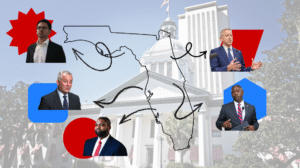

In 2022, Florida Gov. Ron DeSantis delivered his “Florida is where woke goes to die” speech at the dawn of his second term, a stand-out moment in his tenure where he promised to reshape Florida’s public education system. In 2026, he has arguably made good on this promise.
DeSantis’ education legacy has been defined in large part by legislation such as the Stop WOKE Act (2022) and Don’t Say Gay bill (2023), plus a passion for stamping out all things diversity, equity and inclusion (DEI) from public K-20 education. Now that his second term is ending, it would seem he had garnered everything he wanted in that department. But his State of the State Address on Jan. 13 suggested that he’s not done yet.
“Seven years ago, many took for granted that education was held captive by the ideological fads championed by the political left,” DeSantis told the Florida Legislature and members of the public. “Not us. We’ve defeated attempts to force boys into girls’ sports, to inject gender ideology into elementary schools and to deny parents the right to direct the education and upbringing of their children. We have ensured that our schools have a duty to educate, not a right to indoctrinate.” This comment was met with a standing ovation.
This year, more than a dozen bills that would continue to influence Florida’s education system are up for consideration. Should they pass, they will affect the books students can read, the flags they can wave, even what categories of students can enroll in the state’s universities. As the DeSantis administration promises to go out with a bang, here’s how the shockwaves might be felt in Florida schools.
Higher education bills: Shutting out noncitizen students, political activity on campuses and intellectual freedom
This year’s legislative session arrived alongside a surge of activity by Immigration Customs and Enforcement (ICE) officers in late 2025 and early 2026, and subsequent “ICE Out” protests sweeping Minneapolis, Chicago, New York City and many more municipalities across the nation. In Florida, ICE spearheaded “Operation Tidal Wave,” which led to more than 10,000 arrests in 2025. Students were among these numbers.
Two different bills proposed this year go the extra mile by attempting to control how, or if, international students can enroll in Florida State University System (SUS) schools. HB 721 would cap the number of students “who are citizens of a foreign country” enrolled at an SUS institution at 10 percent of the student body. A bill in the Senate, SB 1052, would prevent higher education institutions from admitting undocumented students and block their access to state financial aid.
Whereas the 1982 Supreme Court case Plyler v. Doe established that states “cannot constitutionally deny students a free public education on account of their immigration status,” this landmark case predominantly applies to K-12 education. The same argument is not as legally airtight in higher education. Three states (Alabama, South Carolina and Georgia) currently have laws that create barriers for undocumented students seeking to attend public colleges by refusing them in-state tuition and state financial aid. This month, Florida joined Texas in implementing a temporary ban on H-1B visas at public colleges and universities, which would further reduce the international presence on campuses by denying work permits to faculty, researchers and other personnel from foreign countries.
The avenues for civic engagement at higher education institutions could also be reshaped this year. SB 1736 creates new guidelines for “political activity” at public colleges and universities—primarily that institutions must provide equal opportunities for Republican and Democratic candidates or elected officials before engaging in on-campus events or debates, including voter registration events. This bill would also require all political figures and organizations to receive approval from the institution before coming to campus.
The bill has received criticism from organizations such as the American Civil Liberties Union (ACLU) of Florida for imposing “unconstitutional restrictions” due to the need for institutional approval before engaging in speech. PBS and NPR affiliate for Southwest Florida, WGCU News also reported that critics such as Rep. Anna Eskamani (D-Orlando) claim that SB 1736 will create “deliberate new barriers to campus civic engagement.” Meanwhile, Republican proponents—such as bill sponsor Rep. Peggy Gossett-Seidman (R-Boca Raton)—have said that the bill will “promote fairness” for Republican students on campuses who may feel they are unable to start their own political student clubs.
The rights of students themselves to engage in civic or political activities is also being debated this year, thanks in large part to HB 1471, a bill that would grant the sitting Chief of Domestic Security—currently Mark Glass, appointed by DeSantis in 2022—the power to designate organizations, nonprofits and student groups as domestic or foreign terrorist organizations. The Chief of Domestic Security’s designation would need to be approved by the Governor and their Cabinet.
The bill includes a provision stating that any student found to be “promoting” a designated terrorist organization is to be expelled and ineligible for institutional or state grants, financial aid or scholarships. The bill fails to define what counts as an example of the promotion of such a group.
The ACLU of Florida has criticized HB 1471 for giving a small group of government officials the power to designate organizations as terrorist groups without due process.
“The Trump Administration has repeatedly claimed its critics are ‘domestic terrorists,’ including after federal agents shot and killed Renee Good and Alex Pretti,” Executive Director of the ACLU Florida Affiliate Baccardi Jackson said in an official statement. “If this bill were passed, it would provide state officials yet another tool to target people and organizations they don’t like.”
Student organizers based in Tallahassee have also spoken out about their concerns that this bill will be used to target Muslim students and community members and student protestors more broadly.
HB 1471 passed through both the House and Senate by March 5. At the time of this article’s publication, it is sitting on the Governor’s desk, awaiting final approval.
There’s also HB 347, which would prohibit any public school, college or university from displaying a flag which “represents political partisanship, political ideology, race, gender or sexual orientation” on its “real property”—meaning the land owned by the campus or any of its permanent fixtures.
This is the third year in a row that the Florida legislature has considered this bill, and critics have claimed that previous iterations specifically targeted LGBTQ+ flags, Black Lives Matter flags and Palestinian flags that students may want to display during protests or in student centers or dormitories on campus. This year, HB 347 also makes an exception for flags of “historical significance” to the state, a carveout detractors claim has been made to allow for the Confederate flag to be displayed at schools.
While HB 347 would apply to both K-12 schools and universities, it creates specific challenges for higher education institutions by failing to make a distinction between public and private space. HB 347 does not clarify whether flags would be banned merely from public-facing campus areas, such as flagpoles, or if they would also be prohibited in student dormitories, faculty members’ private offices or at student-run campus events.
The Florida legislature also appears to have prioritized honoring the life of co-founder of Turning Point USA and right-wing conservative activist Charlie Kirk this year. Kirk, a resident of Longboat Key in Sarasota County, Florida, was murdered in September 2025 during an on-campus political event at Utah Valley University. Kirk was well-known to consider higher education a “scam” and encouraged young Americans to not pursue a degree.
The Florida legislature has proposed creating a statewide “Charlie Kirk Day of Remembrance” on Oct. 14, designating a street in Miami-Dade County the “Charlie Kirk Memorial Avenue” and redesignating roadways on 40 Florida college campuses to be renamed after Kirk.
K-12 education bills: The right to read, religious expression in schools and fetal development education
Book bans are another issue that has plagued Florida’s education system for years. This is due in large part to HB 1069 (2023), a law which requires that any book that is argued to depict or describe “sexual content” be immediately removed from public K-12 schools, pending review. This law has come under legal scrutiny at the federal level for violating the First Amendment.
Anti-book banning advocates often point to the Miller test when defending the right to read, a Supreme Court standard which states that a book’s literary, artistic, scientific and political value must be considered before it is banned, and requires that the book’s value as a whole be considered as opposed to banning a book due to a single sentence or paragraph which may be objectionable to some. HB 1119 seeks to do away with the Miller test in Florida which critics fear will lead to further book bans and subsequent litigation.
Another bill that critics claim will lead to increased book bans is HB 31—although it threatens to do much more. HB 31 would prohibit the use of the term “West Bank” in government materials, including instructional and library materials in public K-12 schools and charter schools. Instead, these books and other educational materials would need to be replaced with those that call the same region “Judea and Samaria.” Critics claim that this bill will force politicized speech on Florida schools and is an example of anti-Muslim and anti-Palestinian rhetoric. Notably, Florida passed a similar law last year mandating that all references to the “Gulf of Mexico” in instructional materials in K-12 schools be replaced with those that say “Gulf of America.”
Two other bills, HB 147 and HB 371, titled “Oaths of Classroom Teachers” and “Patriotic Displays in Classrooms” aim to promote patriotism in public schools. The former would require educators to take what some news publications are calling a “loyalty oath,” wherein they would swear to “support, protect, and defend the Constitution and Government of the United States and the Constitution and Government of the State of Florida.” The latter would require portraits of George Washington and Abraham Lincoln to be installed in all K-5 classrooms.
One final bill, HB 1071, is what is called an omnibus bill—a single piece of legislation that packages together several different measures and subjects. HB 1071 includes provisions about:
- Book bans — The Education Commissioner would receive the authority to remove all books by a single publisher from the state-approved list of instructional materials, if any single book by that publisher is found to violate Florida law.
- DEI funding — This bill would ban public and charter K-12 schools from spending state or federal funds on promoting, supporting or maintaining any campus clubs, programs or activities that advocate for DEI or political or social activism, much like SB 266 (2023) which applies the same ban to public higher education institutions in Florida.
- Fetal development education — Would require middle and high school students to be taught “human embryological and fetal development” in the form of what is popularly known as a “Baby Olivia” video, which critics claim is meant to “manipulate the emotions of viewers” instead of sharing scientific or factual information about pregnancy, fertilization and fetal development.
The status of every bill described in this article remains in flux. Legislative session formally ends on March 13.